Showing posts with label China. Show all posts

Monday, June 19, 2017

The ruins of a Chinese city, turned into a museum after the Great Sichuan Earthquake


On May 12th, 2008, a magnitude 8.0 earthquake hit a mountainous region in southwestern Sichuan province of China. Over 70,000 people lost their lives while hundreds of thousands were injured and 5 million remained homeless. 

In Beichuan county 3,000 to 5,000 people were killed and 80% of buildings were destroyed. Qushan Town which was until then Beichuan's county seat was abandoned but instead of pulling them town, authorities decided to stabilize and preserve the ruins as part of the Beichuan Earthquake Museum. There were hydraulic engineering projects to help preserve the site and an underground museum was built at the site of of the old Beichuan High School. 

The Earthquake Museum site also includes Tangjiashan Lake which was formed during the earthquake.  


Thursday, April 13, 2017

The abandoned backlot of Beijing Film Academy

This abandoned backlot of Beijing Film Academy can be found in the heart of Beijing. In the 12-acre site, BFA would film some of China's biggest blockbusters for more than 50 years. Among them, Chinese versions of American westerns and communist propaganda films.

The site combines western and eastern styles, probably as was seen in Shanghai in the 19th and 20th century. Hidden in the backlot, there are are props of warriors and Buddhas left over from older productions. Alleyways lead from more modern hutong scenes into ancient China. 

The studio lot was abandoned about 10 years ago. Some areas have been burned down or have fallen into serious disrepair, while huge lot doors are overgrown with tumbleweeds. 


Thursday, March 30, 2017

Shanghai's largest vacant building: A mall in the shape of Pentagon


It looks just like the US Pentagon but it's double the size! This Chinese knockoff is the largest unoccupied building in Shanghai according to media reports. A classic case of Chinese overspending, Pentagonal Mart, located in Shanghai's Nanhui district, spans out a massive 70 acres (compared to 34 acres for the Department of Defense headquarters in Washington DC.)

Most of the building has been unoccupied since construction ended in 2009 due to the mall's confusing interiors. The mall failed to attract retailers and according to media reports hope remained alive in the form of the Shanghai Disney Resort which opened in June 2016 and it's located just 8 km (5 miles) away.


For more deserted places, LIKE US on Facebook and FOLLOW US on twitter


Monday, August 1, 2016

Beijing's abandoned Olympic venues

To host the 2008 Summer Olympics, China constructed 12 new venues as well as eight temporary ones. Although Beijing received international accolades for its new architectural icons, many venues fell in disrepair after the games as there were no plans for future use.

The largest venue, Beijing's Olympic Stadium, known as 'Bird's nest' costed $471 million to be built which might take China 30 years to pay off. Even though there are plans for it to be used for the 2022 Winter Olympics, again hosted in Beijing, it hasn't been used much since the Olympics. Meanwhile, the Water Cube, as Beijing National Aquatics Center was nicknamed, lost about $1 million in 2011 even after public financial assistance and the addition of a water park.

At the same time, many other venues, like those for kayaking, beach volleyball, BMX, and baseball have been sitting untouched since 2008. In photos, taken the years after the Games, signage and landscaping appear to have gone without maintenance since the closing ceremonies.

Beijing followed in the footsteps of other Olympic cities like Athens and Sochi where sport venues have remained abandoned following the games due to lack of planning. 


For more deserted places, LIKE US on Facebook and FOLLOW US on twitter


Thursday, February 18, 2016

Atlantis of the East: The Chinese underwater city of Shi Cheng


Deep inside the Qiandao Lake in the Zhejiang Province of China, 400 km (250 miles) south of Shanghai, lies the ancient submerged city of Shi Cheng (Lion City). The city was built during the Eastern Han Dynasty (AD 25–200) and was first set up as a county in AD 208. The city was named Chi Cheng from the nearby Wu Shi Mountain, located just behind the city. 

The valley surrounding the city was flooded in 1959 to create the Qiandao lake (also known as Thousand Island lake) for the Xin'an River Dam project. Nearly 300,000 people had to relocate for the project, some of whom had families that had lived in the area for centuries. 

The Lion City was rediscovered in 2001 when the Chinese government organised an expedition to find the remains of the ancient metropolis. In 2011, the Chinese National Geography published some never-before-seen photographs and illustrations which raised international interest for the lost city, with many calling it "the Atlantis of the East". 

Today, Shi Cheng remains submerged at a depth of 26-40 meters (85- 131 feet) and measures about half a square kilometer (123 acres). Expeditions have revealed that the city had five entrance gates, as opposed to the traditional four – with two western-facing gates as well as gates in the other cardinal directions. The city’s wide streets also have 265 archways, featuring preserved stonework of lions, dragons, phoenixes and historical inscriptions, some of which date back as far as 1777.

Even though it is submerged, Shi Cheng has remained well preserved as the water actually protects the ruins from wind, rain and sun erosion. The city isn't yet fully mapped so the diving into it is considered exploratory and limited to only advanced divers who can visit it between April and November. 


SEE ALSO: More underwater abandoned places // More abandoned places in China // LIST OF ALL DESERTED PLACES 
For more deserted places, LIKE US on Facebook and FOLLOW US on twitter


(Click here for the full post)


Monday, December 7, 2015

An abandoned Chinese fishing village, overtaken by nature

This Chinese fishing village has been left abandoned for more than 50 years, and now has been overtaken by nature. The village is on Gouqi island, one of the 394 islands that form the archipelago of Shengsi islands. Although the area still attracts over 100,000 fishermen every winter, fishing practices have diminished during the last decades leading to the abandonment of previously flourishing fishing villages. 


Monday, August 25, 2014

Ordos, China: The world's largest ghost town


Kangbashi New Area, part of Ordos City in the Chinese Inner Mongolia, was built in 2004 to house 300,000 people. It was part of an ambitious plan to create a glitzy, state-of-the-art commercial and residential zone that would house affluent citizens. 17 billion yuan were spent to transform the area into a  postmodern metropolis with spaceship-like government towers, Dubai-style skyscrapers, museums, libraries, theaters, sculpture squares and luxury bungalows.

However, only about 2% of the buildings were filled. High home prices were blamed for keeping prospective buyers away. Today about 20,000-30,000 people live in the city which has population density of 469 people per square kilometer, which is less than 5% of the average for Chinese small cities. As the city remained virtually empty, prices fell from $1,100 per square foot in 2006 to $470 a square foot in December 2011 but that wasn't enough to attract new buyers. 

Today, most of residents of the district are government employees who bought their houses with a discount of 50% or more. The remaining houses were bought by coal tycoons who then chose to live elsewhere.


Monday, December 2, 2013

China's newest -and emptiest- airport terminal


Shenzhen Bao’an International Airport's Terminal 3 opened last week receiving much praise for its design. The terminal, which cost 740 million euros (1.01 billion US dollars) was seen as a symbol of China's explosion onto the world stage of global travel. Rome based Studio Fuksas designed an enormous terminal covering 400,00 sq. meters (4.3 million sq. feet). It can handle up to 45 million passengers a year but so far nobody seems to want to go there. Only one European airline is operating from the airport offering trips to Helsinki, and the only flights to the US are cargo planes to Anchorage in Alaska.

One of the reasons for the low interest could be that Shenzhen (which is in close proximity to Hong Kong) doesn't allow visa-free stop overs, unlike other Chinese cities. If more airlines will choose to use Terminal 3 in the future remains to be seen. Until then, it will remain a shiny but empty space.


SEE ALSO: More abandoned airports around the world // More abandoned places in China // LIST OF ALL DESERTED PLACES 
For more deserted places, LIKE US on Facebook and FOLLOW US on twitter


(Click here for the full post)


Wednesday, August 7, 2013

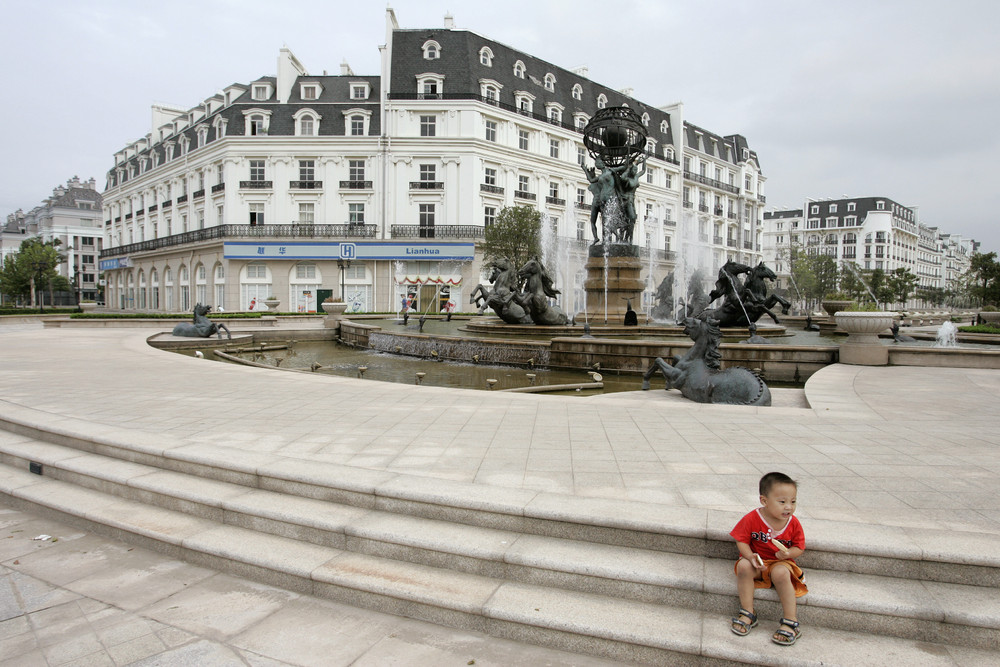
A Parisian ghost town in the middle of China


The gated community of Tianducheng, located near Hangzhou, the capitol of China’s Zhejiang province was built to resemble Paris, complete with a 108-meter (354-foot) replica of Eiffel tower, and 31 square kilometers (12 square miles) of Parisian style architecture, fountains and landscaping. 

The town opened in 2007 after 5 years of development and was supposed to accomodate more than 10,000 residents. However, it still remains scarcely populated and local media call it a ghost town.


Thursday, January 3, 2013

The largest -and loneliest- shopping mall in the world

New South China Mall located in Dongguan, China has the title of the largest shopping mall in the world based on gross leasable area but it might also be the world's emptiest one. Today, out of its 659,612 square metres (7,100,000 sq ft) of leasable space -and 892,000 square metres (9,600,000 sq ft) of total area- only about 1% of it is occupied, leaving the areas away of the building's entrance deserted. 

The mall has seven zones modeled on international cities, nations and regions, including Amsterdam, Paris, Rome, Venice, Egypt, the Caribbean, and California. Features include a 25 metres (82 ft) replica of the Arc de Triomphe, a replica of Venice's St Mark's bell tower, a 2.1 kilometres (1.3 mi) canal with gondolas, and a 553-meter indoor-outdoor roller coaster. While the mall has 2350 leasable spaces, only 47 are occupied.

The low occupancy of the world's largest mall is blamed on its location, away from the city's center, and the difficult access as there is no highway close to the mall and it's only accessible by car or bus.